

A project to improve due diligence passporting between INGOS and local NGOs
In late 2025, a consortium led by World Vision UK, together with Plan International, ActionAid, and Tearfund, with funding from the Disasters Emergency Committee, commissioned Humentum to support their passporting initiative. The engagement involved a review of global due diligence reform and passporting approaches, coupled with technical support to help shape the design of a more streamlined and collaborative due diligence model.
The review phase is complete, with the goal of finalizing the new initiative in early 2027.
When duplication delays support
Imagine if you had to fill out a form every time you needed to drive somewhere. And what if the form changed depending on where you’re going — even though you’re always the driver, using the same vehicle, with the same license and insurance.
That’s essentially what due diligence looks like for many NGOs and nonprofits. Every time an organization applies for funding (even when a funder approaches them first), the staff has to complete a new assessment using different forms and formats, even when the information is mostly the same.
The result: everyone spends more time and uses more resources, while funding decisions get delayed.
Recognizing these challenges, organizations have been exploring ways to streamline requirements, harmonize assessment approaches, and promote greater mutual recognition between organizations. One of these approaches is due diligence passporting.
Due Diligence Passporting
The goal of due diligence passporting is that multiple donors, INGOs, and funding partners recognize and build on a shared assessment rather than requiring individual assessments of the same organization. Done well, it saves time, reduces administrative burden, lowers transactional costs, strengthens trust between partners, and most importantly — gets resources to those who need them faster.
Despite growing interest in improving the process, duplication remains a practical challenge. In ordinary times, it creates administrative and compliance burden. In emergencies when funding needs to move quickly and local organizations are already positioned to respond, repeated due diligence checks can slow decisions, delay partnerships, and divert scarce local capacity away from immediate relief.
That was a challenge facing local NGOs following a major natural disaster. International aid agencies were ready to move funding. Local NGOs were positioned to respond. But due diligence remained a bottleneck.
A real-time review by the Disasters Emergency Committee found that, despite efforts to streamline compliance requirements after the disaster, local responders still had to complete multiple assessments by different INGOs. The result was strain, duplicated effort, and, in some cases, delays to program delivery of weeks or even months.
“Our team was talking about some of the challenges that organizations face at a time when speed is crucial,” said Kevin Panicker of World Vision UK.
We want to reduce the administrative burden that’s involved in any situation where funding is going from an international NGO to a local organization. We chose to work with Humentum on this initiative because we felt they understood what we were asking for. They understand the language; they understand the desired outcomes. – Kevin Panicker, World Vision UK
First step: Understanding what already exists
“This initiative began with a question: why does due diligence look the way it does, who carries the burden of it, and what would a system designed around local organizations rather than around institutional convenience actually look like?” said Shila Nhemi, a technical director at Humentum who has expertise in risk and governance.
Passporting was not the starting assumption; it was one possible solution that emerged from a rigorous process grounded in evidence, context, and the experience of those who live with due diligence every day. – Shila Nhemi, Technical Director, Humentum
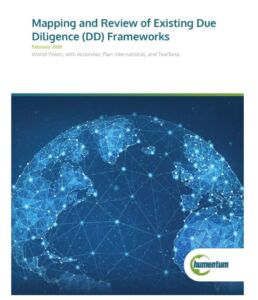
Humentum started the work with a global mapping of due diligence reform efforts. The review examined current tools, passporting initiatives, shared assessment platforms, certification approaches, and other collaborative models. It included efforts led by alliances, networks, and multi-stakeholder initiatives, with the goal of understanding what had worked, what had not, and the barriers that prevent harmonized approaches from translating into practice.
“The objective was not to eliminate due diligence,” said Shila. “Good due diligence remains fundamental to accountability. Passporting does not make risk disappear. It reduces the unnecessary burden of asking local organizations to prove themselves over and over again often using different forms and sometimes in the middle of a humanitarian emergency.
The research showed that, while reform is promising, the results are mixed. Even when tools align on paper, organizations often continue to conduct their own additional reviews, which limits the reduction in burden for local partners.
Four broad approaches have been tested or are currently in use:
- Passporting: One organization accepts another’s assessment, in whole or in part, in lieu of conducting its own.
- Harmonization: Two or more organizations agree to use the same tool, but each conducts its own assessment independently.
- Standards and certification: Organizations are assessed against an externally recognized standard (such as the Core Humanitarian Standard or the Good Financial Grant Practice standard), providing independent verification.
 Hybrid approaches: Combinations of the above, typically pairing a harmonized tool with capacity strengthening support and facilitated implementation, or agreeing to passport the results of a harmonized tool across participating organisations.
The output of this phase was a report that examines existing global evidence on due diligence reform and evaluates what would be required to adapt an established model for the consortium’s context.
You can read a summary report here.
Second step: Stakeholder consultations
The consortium then moved into stakeholder consultations, gathering data from at least 70-80 international and local organizations. Through surveys and conversations about their experiences of due diligence and their views on a passporting mechanism, common themes emerged around what would make a shared due diligence process practical and useful: a centralized data platform, a standardized form/template agreed in advance, and the need for privacy protections.
Another common theme was the complexity of determining organizational legitimacy. A typical due diligence question is whether an organization is registered with the government, because that registration is viewed as a proxy
“In many settings, formal recognition is often viewed as one indicator of legitimacy and accountability,” according to the in-country project lead. “However, stakeholders noted that in complex and evolving environments, legitimacy may also be demonstrated through community trust, effective governance, proven service delivery, and accountability to the populations served.”
There are many reasons why a local organization is not registered. But if the government is opposed to NGOs, limits civil society space or restricts certain types of organizations, then the NGO may not have a choice about carrying out its work without registering. “Stakeholders highlighted that organizations operate under diverse legal and administrative arrangements depending on their context,” said the in-country project lead. “As a result, formal recognition alone may not provide a complete picture of an organization’s legitimacy, capacity, or accountability.”
Next steps
Taking all the data and observations into account, the outcome of the initiative will be a shared due diligence passport that makes it possible for participating organizations to recognize and build on existing due diligence assessments, reduce duplicate information requests, and make faster partnership decisions while maintaining their own risk management, accountability, and compliance requirements.
“Ideally both INGOs and NGOs would use a passporting tool instead of their own completely unique forms and data requests,” said Kevin.
What can INGOs and NGOs do right now?
While much good work is going on (including the Charter for Change), what can an INGO do in the meantime to streamline their due diligence requirements?
- Shift your mindset: “The main thing is a willingness to adjust and adapt the standard processes,” said Kevin. “You don’t have to change completely but are you willing to accept a certification done by another organization, if you’re an INGO.”
One example of a shared passporting process is Alliance 2015. The ACT Alliance, an integrated approach of faith-based humanitarian agencies, is another example. - Proactively communicate: For an NGO, “Communicate any pre-existing due diligence you’ve done. You can’t know if they’ll accept it, but it’s a good first step,” said Kevin.
- Start in advance: Any steps NGOs can take before a natural disaster or crisis is to work on partnerships ahead of time. Identify organizations you’re aligned with who have similar values and focus on related types of work. If you align now in a partnership and create shared due diligence documentation, you’ll be that much farther ahead.
- Use external tools: Make sure you follow the accounting standards for your region/state, country, and sector. If your organization can be audited, make sure that’s happened.
“Meaningful reform in due diligence will not come from waiting for a perfect model, nor from standing at a distance and judging imperfect attempts. It will come from organizations willing to test ideas, learn from what they build, and keep improving. Some will work better than others, and that is precisely how progress is made: through evidence, practice, and refinement,” – Shila Nhemi, Technical Director, Humentum
If you want to improve due diligence as a funder or an NGO, Humentum can support your journey. Please reach out to us.
World Vision is a global, multi-mandate organization with a presence in more than 100 countries. As a faith-based nonprofit, they work on long-term community development,
emergency response, and peace building, with a specific focus on children.
Humentum is the leading global nonprofit strengthening social good practice and effectiveness for nonprofits and funders. We help organizations navigate change and enhance their long-term resilience through experienced consulting, practical training, and curated tools and templates in our Solutions Hub platform.