
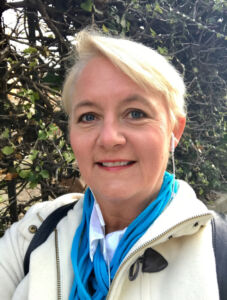
What one safeguarding specialist’s journey reveals about investigations, power, and doing no harm.
From early influences to a career in safeguarding
For Tina, working on protection from sexual exploitation, abuse, and harassment (PSEAH) was a natural outcome of her long-standing interests and professional experiences. Her path into safeguarding was shaped early on by reading and paying attention to how power, inequality, and silence affect women and children.
Starting at a young age, she gravitated toward stories that examine what happens when power is misused, and people are left without protection.
She remembers reading The Burning Bed and The Handmaid’s Tale, as well as novels by Norwegian author Herbjørg Wassmo that dealt with themes of child abuse, loneliness, and survival.
“These were the books that kept me up at night,” she says.
That early interest shaped how she viewed the world and her place in it. Tina went on to study political science, anthropology, and languages before joining the United Nations, where she worked closely with women’s rights organizations such as the Women’s International League for Peace and Freedom and the Women’s Refugee Commission.
She also met influential figures in the gender equality movement, including Bella Abzug, a prominent feminist leader and former U.S. congresswoman—experiences she describes as deeply formative.
“I think I was trained by all of that,” she reflects. “By the people I met and the conversations we were having.”
Working across contexts and seeing the same patterns
Tina went on to hold senior roles across international organizations, including with the United Nations High Commissioner for Refugees (UNHCR), The United Nations Population Fund (UNFPA), The Inter-American Development Bank and the International Federation of Red Cross and Red Crescent Societies (IFRC). Eventually, this work led her into more specialized safeguarding and PSEAH roles.
“It became part of everything I did,” she explains. “No matter the title, the issues were always there.”
Her work took her to crisis-affected contexts such as Niger, Ukraine and Haiti, where she was directly involved in protection and coordination efforts.
Regardless of region or income, Tina noticed the same issues kept resurfacing everywhere: underreporting, limited resources, unclear responsibilities, weak investigations, and systems that failed to support survivors.
“There are many similarities between all types of countries in how the safety of women and children is addressed,” she says. “And unfortunately, it’s often not addressed enough.”
Today, Tina supports the Global Partnership for Education (GPE) on the implementation of their safeguarding policy. While administratively housed under the World Bank, GPE operates independently, working on education reform in countries affected by crisis.
In her experience, safeguarding is often treated as a compliance requirement or disconnected from local realities. Reporting mechanisms may exist on paper, but survivors often struggle to access real support. Their safety and well-being also depend on whether local health services are equipped to respond — for example, whether clinics have trained staff, appropriate medical protocols, or the ability to collect forensic evidence.
Adding to the difficulty, international actors too often maintain parallel systems instead of strengthening what already exists in the countries where they work. This leaves survivors navigating fragmented support, moving between internal organizational processes and national services that may be under-resourced or disconnected.
Another challenge: investigations may be launched without sufficient training or a survivor-centered approach. “It is a societal problem that women and even children are sometimes partly blamed for their own abuse.” You have to be trained so that even in the questions or the analysis, the person doing the investigation isn’t blaming the victim, directly or indirectly.
There’s a misconception that if a policy exists, the problem is solved. But policy alone doesn’t protect anyone.