


Ayat Shawish has spent two decades building community from the inside out, co-founding NAYA Community Network in Zarqa, Jordan, leading programs on sexual and reproductive health, gender equality and mental health, and serving as President of the Y-Peer Association.
Like many project leaders, she had spent years working with budgets and donors without ever having formal financial training. At some point, that gap became impossible to ignore.
That’s what led her to Humentum’s Finance DPro.
She shares with us why she decided to take a finance course designed for non-finance professionals and how it shifted the way she makes decisions and leads her work.
Tell us about yourself, your journey into project management, and the work you’re leading at NAYA and Y- Peer Association – what drives you?
I began my journey in community work during my school years through activities such as scouting, theatre, and the school radio. At the time, I didn’t recognize this as “volunteering”, I simply felt a genuine desire to connect with my community and contribute in meaningful ways.
I pursued a Bachelor’s degree in English Literature, followed by a Master’s degree in Journalism and Modern Media. After graduating, my work in the community expanded beyond university and home. Since 2005, that early interest has grown into a lasting passion and commitment.
My husband and I later co-founded NAYA Community Network, a civil society organization that has become one of the leading organizations in Zarqa, Jordan. We built NAYA based on the needs we personally experienced as young people, creating opportunities, safe spaces, and initiatives that we once lacked.
Today, I serve as Executive Director of NAYA. My work focuses on designing and leading development programs for children, youth, and women, with a strong emphasis on sexual and reproductive health and rights (SRHR), mental health and psychosocial support (MHPSS), gender equality, and inclusive community development.
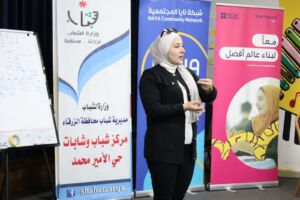
In parallel, I began my journey with Y-Peer in 2006 as a volunteer and now serve as the President of the Y-Peer Association in Jordan, continuing to support youth-led initiatives and peer education.
Alongside managing projects, I also develop new project ideas, including proposal writing, budgeting, and partnership engagement, and I train final-year media students.
What drives me most is the deep sense of purpose and gratitude that comes from giving back. Our communities are rich with potential, yet often face limited resources and opportunities.
Development work is not about individual gain, but about creating meaningful and lasting collective impact. In the end, when communities grow stronger, we all benefit.
What led you to Finance DPro, a course designed for non-finance professionals, and why did it feel like the right next step for you?
While working in the nonprofit sector, particularly in project management, I found myself constantly dealing with budgets, financial planning, and donor requirements. Despite my deep involvement in these processes, I realized that my understanding of them was largely practical, based on experience, rather than on systematic financial knowledge.
There has always been a gap between leading impactful programs and fully understanding the financial terminology behind them, whether it’s strategically analyzing budgets, making informed financial decisions, or communicating confidently with funding teams and donors.
This need is precisely what motivated me to take Finance DPro: I wanted to enhance my financial knowledge in a way that was relevant to development work, not from a purely technical or accounting perspective, but in a way that would better support project design, implementation, and sustainability.
I felt that Finance DPro was the right next step because it was specifically designed for professionals like myself, non-finance specialists who are still responsible for managing projects, budgets, and resources. The program provided a practical and applicable curriculum that directly connects financial concepts to real-world project management.
At this stage of my career, where I not only manage projects but also develop proposals, design budgets, and liaise with partners and donors, I felt that . closing that gap wasn’t something I could put off anymore. If I wanted to lead effectively and build work that lasts, financial literacy had to be part of that.
You described Finance DPro as a practical reference you’ll keep coming back to, not just a training you completed. What’s one thing you learned from this course that genuinely changed how you think or work?
One of the most valuable things I gained from Finance DPro was shifting the way I look at budgets, from being just a required document to seeing them as a strategic management tool.
Before the course, I used to approach budgets mainly from an operational perspective: allocating costs, ensuring activities are covered, and meeting donor requirements. But through the training, I started to see budgets as a reflection of priorities, impact, and decision-making.
For example, in my current work, I am involved in developing project proposals and budgets for different donors. Previously, I focused mainly on ensuring that all activities were covered financially. Now, I approach budgeting more strategically. I think about cost-effectiveness, sustainability, and how resources can be optimized to reach more beneficiaries without compromising quality.
In one case, this shift helped me redesign a project budget by reallocating resources more efficiently, allowing us to expand the number of participants while staying within the same budget.
This not only improved the project’s impact but also strengthened our proposal when engaging with donors.
What really changed my mindset is understanding how financial planning is directly linked to the effectiveness and sustainability of a project. I became more confident in analyzing budgets, questioning assumptions, and making adjustments that improve both efficiency and results.
This shift didn’t just improve my technical skills, it changed how I lead projects. I now approach financial discussions more strategically, and I feel more confident engaging with finance teams and donors.
That’s why I see Finance DPro not just as a course I completed, but as a reference I continue to go back to whenever I am designing a project, reviewing a budget, or making key decisions.
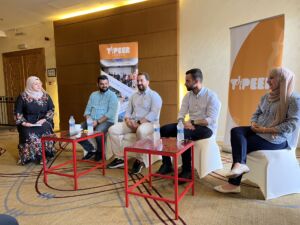
The course is self-directed over 8 weeks, how did you manage that alongside your day-to-day work?
Managing the course alongside my daily work was definitely a challenge, especially at the beginning of the year, which is usually a peak period in my work cycle.
During that time, I was balancing multiple responsibilities, including ongoing project implementation, leading training, coordinating campaigns, and working on new proposals and reporting requirements. The workload was intense, and managing my time required a high level of discipline.
However, I approached the course as an investment in my professional growth rather than an additional task. I made a conscious effort to dedicate specific time slots during the week, often in the evenings or early mornings, to stay consistent and keep progressing.
What made it easier was that the course content was highly practical and directly connected to my daily work. I was able to immediately apply what I was learning, whether in budgeting, proposal development, or in financial discussions within my team.
There were moments when it felt overwhelming, but focusing on the long-term value of the course helped me stay committed. The flexibility of the self-paced format also allowed me to adjust my schedule when work demands increased.
In the end, it came down to prioritization, consistency, and seeing learning as part of my role, not separate from it.
As Projects Lead at NAYA and head of YPeer Association, you’re juggling a lot of responsibilities. How does stronger financial literacy help you manage your workload across both roles?
In my role at NAYA, I don’t just deal with budgets as numbers anymore. I work with them as part of the story we are telling to donors and partners. The financial narrative became a key part of how I design projects, making sure every cost reflects a real need, a clear logic, and a meaningful impact.
For example, working with our partners at Oxfam, I found myself going back to what I learned in Finance DPro repeatedly. Whether I was reviewing budgets, aligning activities with available resources, or preparing reports, I used the course as a practical reference to guide my decisions and ensure that everything is consistent and well-justified.
Instead of feeling limited by budgets, I now see them as flexible tools. There were moments where I was able to rethink allocations and use the same resources more effectively, reaching more beneficiaries and improving the quality of implementation without increasing costs. This kind of thinking helped me manage both expectations and realities more confidently.
With YPeer, where resources are often limited and initiatives are volunteer-driven, financial awareness became even more important. It pushed me to think creatively about how to design initiatives that are realistic, efficient, and still results-driven.
What really changed for me is that I no longer separate program work from financial work. The budget is part of the program itself, and the narrative behind it is part of the impact.
And honestly, Finance DPro became something I go back to continuously; a practical guide I rely on to make better decisions and achieve stronger results in both roles.
What’s your advice to other professionals in the region who are leading projects but never had formal financial training?
My advice is simple: don’t wait until you feel “ready” to understand finance. Just start.
I used to think that financial literacy was something “technical”، something for accountants, not for someone like me working directly with communities. But the reality is, once you start seeing budgets as part of your story, not just numbers on a sheet, everything changes. You become more confident and more in control of your work.
I would also say: don’t be afraid to ask questions, to challenge numbers, and to learn through practice. Some of my biggest learning moments came from real situations writing proposals, adjusting budgets, or trying to make things work with limited resources.
For me, Finance DPro changed how I think — and it’s something I continue to go back to as a guide whenever I want to make better decisions and achieve stronger results.
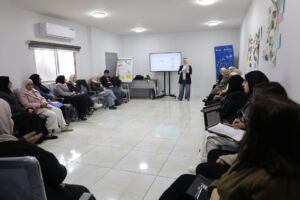
*Images courtesy of Ayat Shawish, Y-PEER Jordan, and NAYA Community Network
Ayat is part of a over 2,000 development professionals who have taken Finance DPro to build practical skills in budgeting, forecasting, financial reporting, and risk management.
If you lead projects, manage budgets, write proposals, or work with donors, you do not need to be a finance specialist to make stronger financial decisions. You just need the right training.
Financial Management for Development Professionals (Finance DPro) can help you make stronger, more confident decisions.
Finance DPro also prepares you for a globally recognized certification through PM4NGOs.