


Over the past year, funding for Kenya’s health sector has been shifting fast, with donor support contracting and new government-to-government (G2G) financing arrangements emerging. Against that backdrop, Humentum and HENNET (Health NGOs Network of Kenya) set out to build a genuine partnership, one that could hold up under pressure and uncertainty. Aisha Tambajang, Humentum’s Senior Program Manager, and Sharon Musakali, HENNET’s Program Manager, sat down to reflect on what that partnership actually took, including co-developing a Strategic Blueprint for Health Civil Society Collective Action together. Here’s what we learned.
Partnership is one of those words we use constantly in the development sector. We talk about equitable partnerships, locally led development, and shifting power. But what do those ideas look like when we have to practise them, between organisations with different histories, resources, and positions in the system?
Over the past year, Humentum and the Health NGOs Network (HENNET) in Kenya have been exploring that question together.
Our relationship did not begin with a detailed partnership strategy. It grew from an informal connection at the International Conference on Family Planning into a more intentional conversation. Rather than leaving with a promise to reconnect, we made time to explore what collaboration could look like and left with concrete next steps.
Since then, the work has grown through working groups, convenings, and the development of a civil society Blueprint. Just as important as what we have produced is what we are learning about how partnership itself gets built.
1. Sometimes the partnership has to emerge before you can fully define it
Development work often encourages us to know the destination before we begin: define the outputs, agree on the roles, build the workplan, and implement.
Our experience has been less linear. The partnership evolved through conversation, experimentation and responding to what was happening around us. Humentum’s TIME Transformation Lab, which supports organisations and networks to explore, test and learn what transformation looks like in practice, had enough flexibility to respond as opportunities emerged, while HENNET grounded the work in the realities of Kenyan civil society. Through a Working Out Loud approach, TIME also makes that learning visible so it can be shared, challenged and adapted across contexts.
We have come to see emergence not as the absence of design, but as a different approach to design. We still make intentional choices, but leave room to ask: What are we learning? What has changed? What is needed now?
2. Learning how to work together is part of the work
Partnership does not automatically become equitable because two organisations want it to be.
At the beginning, we were learning each other: how each organisation works, who coordinates what, where decisions sit, and what pressures each of us is managing.
At one point, there was uncertainty about whether this was primarily a Humentum initiative in Kenya or a process that genuinely belonged to Kenyan civil society. Feedback from participants made that tension visible: people wanted more Kenyan voices and local leadership.
We had to listen and adjust. At times, that meant HENNET taking a more visible coordination role while Humentum contributed more behind the scenes. At others, it meant consciously creating space for Kenyan voices to lead.
We learned that equitable partnership does not mean both organisations being equally visible. It means understanding whose leadership is needed, when, and being willing to shift roles.
The absence of tension is not the measure of a strong partnership. The ability to work through tension may be.
3. You cannot talk about equitable partnership without talking about power
Funding, reputation, access to international spaces, geography, race, and whose expertise is recognised all shape how organisations interact.
Our conversations surfaced uncomfortable reflections on how international and national partnerships can work. The dynamic can easily become: they decide, we implement. That risks reproducing colonial patterns in which the organisation controlling resources is assumed to hold the greatest authority.
Working differently requires us to challenge the idea that financial contribution is the only form of value.
HENNET brings knowledge of Kenya’s health and civil society ecosystem, relationships, legitimacy, and coordination capacity. Humentum and TIME bring facilitation approaches, transformation methodologies, systems thinking, learning from other contexts, and wider networks.
For us, practising equity means asking where power sits and whether our ways of working reinforce or challenge existing hierarchies. Sometimes the most useful thing one partner can do is open a door. At another moment, it may be to step away from the centre.
The objective is not equal visibility. It is shared ownership and better outcomes.
4. We show up as people, organisations, and parts of wider ecosystems
Partnerships are often described as relationships between organisations. But organisations do not build relationships with one another, people do.
As Aisha and Sharon, we come from different national and organisational contexts, but we are both African women who have worked in and alongside civil society on the continent. Our experiences are not the same, and Kenya and The Gambia are not interchangeable. But there are realities we have not always had to translate for one another.
We recognise what it means to work where plans shift quickly, where organisations manage multiple pressures, and where practical conditions, from connectivity and infrastructure to institutional demands, shape how work gets done. We also understand some of the political, social, and cultural realities underneath that work.
Our positionalities are also different. HENNET is embedded in Kenya’s health and civil society ecosystem. Humentum is a global organisation, and Aisha works within that space while bringing lived experience of African civil society. Those differences help us ask harder questions: Whose knowledge is centred? Who has access to which spaces? Who can bridge between them?
This is also where South–South learning becomes valuable. Experiences can travel between African contexts without becoming templates to copy. We can ask: What resonates here, what is different, and what can we learn from one another?
5. The value of partnership is in what becomes possible together
At one point in our conversation, we asked: does HENNET + Humentum equal two, or does 1 + 1 become something more?
HENNET has brought the relationships, legitimacy, and knowledge that root the work in Kenya and gave it somewhere to live beyond a particular project. The Blueprint is already showing what that can mean, with HENNET exploring how its values and ways of working might influence how members coordinate and collaborate.
Humentum and TIME bring methods for facilitating transformation, systems thinking, learning across contexts and connections into wider networks.
The additional value shows up in the exchanges between them:
- When a relationship held by one partner opens a door for the other;
- When a local challenge reshapes a method;
- When learning from one context sharpens questions in another;
- When individual relationships begin connecting wider ecosystems.
For HENNET, SDG 17 (the UN’s Sustainable Development Goal on partnerships) is central to how we work. This partnership demonstrated what it can look like in practice: bringing together HENNET’s local knowledge, relationships and convening role with Humentum’s transformation approaches and wider networks. By combining these different strengths and sharing leadership, we created something neither organisation could have achieved alone.
That is where 1 + 1 becomes more than 2.
We are still working it out
We are not sharing a finished model of partnership. We are still inside it.
Too often, we ask organisations to collaborate without creating the conditions that make collaboration possible. We ask for co-creation but arrive with predetermined outcomes. We ask national organisations to lead but retain control of resources and decisions. We ask people to coordinate and build relationships but rarely resource that work adequately.
If we want different partnerships, we have to create different conditions for them.
For us, that means:
- Time to build trust
- Flexibility to change direction; resources for coordination and relationship-building
- Honesty about power
- Willigness not to gatekeep relationships or opportunities
- Space for disagreement
- Respect for different forms of value
- Imagining resources and leadership sitting differently in the future
- Enough humility to know when to lead, when to follow, and when to get out of the way
Partnership is not an arrangement we perfect at the beginning. It is a practice.
Our invitation to funders, intermediaries, networks and civil society organizations is simple: Do not only ask who you should partner with. Ask what conditions you are creating for that partnership to become something neither of you could have built alone.
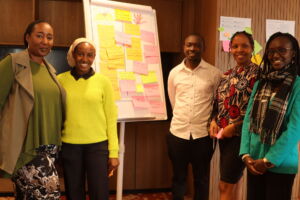
What emerged from this collaboration is a Strategic Blueprint for Health Civil Society Collective Action in Kenya. It brings together more than a year of collective sensemaking, consultation, and action with Kenyan health civil society. It sets out four priorities for collective action, shared commitments for how organizations work together, and practical steps for stronger coordination and collective influence.
Download the Blueprint to explore the full findings and recommendations